It was a peculiar complaint, and was levied by an old friend of mine.
His only exposure to cube drafting was the Magic: The Gathering Online cube, which strips the format down to its barest elements. The online drafting experience lacks the camaraderie of passing packs with a group of friends, chuckling over card picks and fist-pumping as a bomb wheels back around the table. Online, there's just your picks, deck construction and matches. Your basic limited environment. Naturally, he evaluated it as one.
His complaint struck at the core of the drafting experience. Fundamentally, a draft is an interactive deckbuilding exercise. Unfortunately, in his eyes, the interactivity was largely lacking. You mostly selected an archetype, picked that archetype's cards, and hoped for the best.
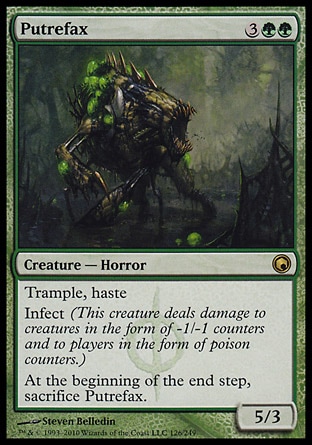
Setting aside the validity of the assertion, the sentiment is that the cards supporting various archetypes have very little overlap. In recent memory, Scars of Mirrodin drafting took the concept of disjoint archetypes to the extreme. Scars was home to a real all or nothing archetype, Infect. It wasn't difficult to tell what cards belong to your archetype, and there wasn't a large degree lot of subtlety to the picks. The main determining factor to your deck's strength came down to one thing: how many other people at the table are drafting Infect?
Although there's an argument that the Infect mechanic successfully drove home the theme and flavor of the block, as a player I found the dynamic rather frustrating. There was no halfway with infect. If you started off on an infect deck and discovered around pick four or five that you're being cut from the archetype, what were your options? Where could you transition to? Metalcraft? Dinosaurs? Your infect creatures were beyond useless in other decks. At that point you either jumped ship to another archetype, or resigned yourself to presenting an underpowered Infect deck.
The more you load up on cards that support a single archetype but have no utility in others, the "worse" your draft environment becomes. Quotes because draft can be anything you want really, and all that matters is that you hit your design goals. Any archetypes can be draft archetypes. We could, for example, make a cube that simply take 8 Legacy combo decks and shuffle them together for a draft. We'd have Elves, Dredge, Show and Tell, 12 Post, Storm. Maybe we'd even sprinkle in Modern combos like Eggs and Melira Pod. Each player could draft their combo deck, each hoping nobody else was cutting them from their specific archetype. Drafting would be a little silly, boiling down to identifying which card in the pack goes in your deck and snagging it.
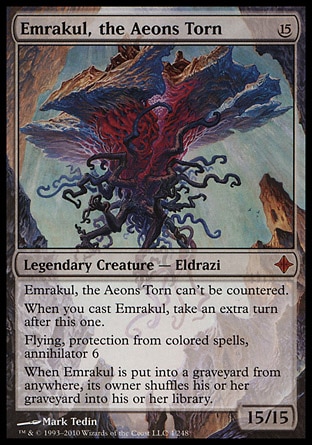
Many cubes are riddled with the same issues as our hypothetical Legacy combo cube. Generally, these issues start with a well intentioned design goal: "to build an environment with many draftable archetypes". However, they reach the "wrong" destination. Rather than constructing a dense web of overlapping archetypes, designers stretch their design space thin. They add cards like Empty the Warrens, Emrakul and Dream Halls.
Where people get led astray is when they start thinking like players in their cube evaluation, rather than designers. Asking "what is good in my cube" instead of "what is good for my cube". From watching and playing the MTGO cube, there is no doubt an archetype like "super ramp Eldrazi" can perform. As players, we're inclined to view this as a success. "See, I produced a winning deck." As designers, we have to take a different approach. Do these cards help us reach our design goals? Is there another approach that would be more effective in helping us reach our goals?
In general, design goals for a cube are less restrictive than design goals for a retail limited environment. Blocks must create an environment that is both mechanically and flavorfully interesting. Flavor sometimes pushes sets into mechanically tricky territory, and even then cohesiveness is the goal. Even when trying to create flavorfully distinct factions, limited design suffers when the mechanics and archetypes cannot be mixed and matched.
The Esper shard of Shards of Alara block was an acknowledged shortcoming, as its "artifacts matters" theme had little mechanical overlap with the adjacent shards.
"As the lead designer of the Esper shard, my biggest regret was that the shard isolated itself so much mechanically from the shards around it. ...If we force subsets upon the public we have to make sure there are synergies between those subsets. The design has to work at the service of what the block is doing. Our biggest mistakes came in places where we weren't serving the block as well as we should." - Mark Rosewater
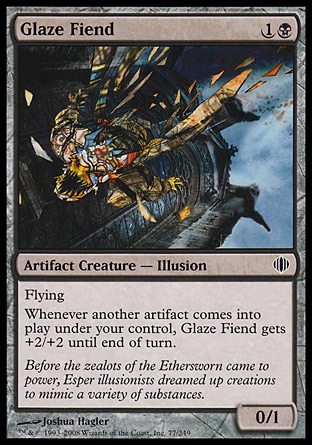
"The second problem was the decision to make the bad guys go the opposite direction of the good guys. Since the good guys team up, the bad guys had a loner theme. I think we pushed the loner theme a little too hard, which made it hard to play black. This partially resulted in the imbalance of the colors I talked about above.
The big lesson for me was that design has to be very careful in what we're asking for. Development can make players do what we ask by putting the power of the set in the proper place, but we have to be careful that we don't ask for something that's fundamentally going to shift the game away from its core." - Mark RosewaterWhich leaves us with the 'Poison Principle'. The more mechanically isolated an archetype is from the rest of your draft environment:
- the more focused decks of that archetype needs to be in order to be successful
- the less other decks will want to include cards of that archetype
The first point is relatively straightforward. If you are trying to draft an archetype like Infect, Eldrazi or Storm, you really need to be fairly all-in on that archetype to have any hope of your deck performing. The second point is a bit more involved, and reveals the most damaging effect of mechanically isolated archetypes.
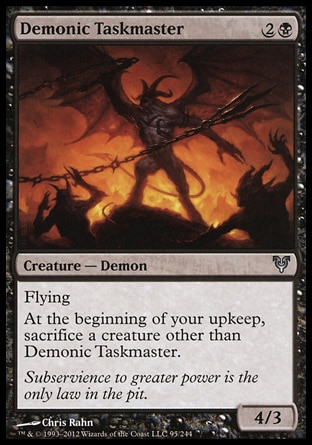 For the sake of illustration, let's simplify a theoretical draft environment to one with five primary strategies. The theoretical decks in this environment are just combinations of two of the five strategies. This leaves us with 10 deck types (think the color-paired guilds of Ravnica). Now, suppose we change one strategy so that it no longer pairs with the other four strategies. As a broad simplification, this is what we had in Avacyn Restored. Black decks wanted to be mono-colored, while the other colors were free to mix and match. Although we may have introduced an interesting deck or mechanic, we have actually cut our deck space from 10 decks to 7. Effectively, we replaced the Orzhov, Rakdos, Dimir and Golgari color pairings with a single mono-black deck. This one change cut our deck space by 30%.
 Cube managers, acting as both design and development, have the freedom to include any archetype in our environment. Moreover, we're not even constrained by any flavor or block demands. We can make players run mechanically isolated strategies by making them sufficiently powerful. Esper was certainly playable in Shards draft, just as "super ramp" is playable in the various iterations of the MTGO cube. Both archetypes, however, suffer from the same breed of design failings.
The Eldrazi archetype brings significant baggage to a draft environment. First and foremost, the Eldrazi themselves. The Holiday MTGO cube ran all three legendary monsters. Traditionally, cube fatties are running triple duty, supporting control, reanimator, and ramp. The Eldrazi are simply uncastable in a regular control shell, and certainly can't be reanimated. Even the standard ramp spells don't stretch you all the way to 10, 11 or 15 mana. The Holiday MTGO cube compensated by doubling down on ramp with a full cycle of Signets and over the top spells like Gilded Lotus, Basalt Monolith and Heartbeat of Spring. Further, it rounded out the package with cards like Channel, Show and Tell, Sneak Attack and Eureka.
Mechanical isolation left and right. Unfortunately for those hoping for an MTGO cube guided by Wizard's modern design sensibilities, the outlook is grim:
The format is a ton of fun, allows for a controlled environment in which to enjoy some of the most broken cards of all time, gives us an avenue to show off contemporary illustrations for old classics, and keeps things fresh in the lag between when new sets come out in paper and online.
We're constantly looking at ways to tweak the online Cube experience (both the card list and the prize structure), but rest assured you'll be able to Channel out Ulamog or Tinker up Blightsteel Colossus many more times over the coming year. - Aaron Forsythe
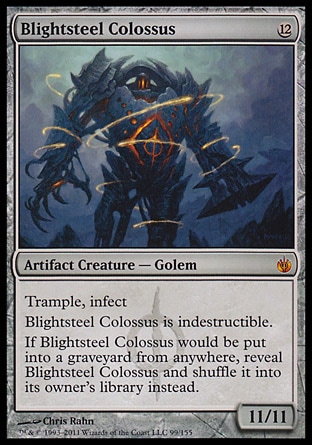
In a constructed setting, broken combos would be described as "format warping". They force out decks that cannot interact with the combo, and lead to a metagame filled with cards like Force of Will and Thoughtseize. Vintage and Legacy are both full of play and interactivity, despite the presence of game-ending combos. In a draft environment, however, the cardpool is static. There are a limited and fixed number of ways to interact with these combos. A limited environment is not self-correcting. Players cannot bring the environment to a healthy equilibrium by overloading on cheap disruption. The format cannot be warped, only worsened.
We're left with insular and mechanically isolated draft archetypes that in any other context would be identified as a design mistake, and broken plays that in any other context would be a universal source of player frustration. What is most disheartening is the fact that cube draftng doesn't even need these particular broken combos to deliver an engaging and satisfying experience. Cube at its best is a balanced and well crafted limited environment paired with powerful cards from throughout the game's history. Don't give us one without the other.
